
In transportation, true failures rarely happen without warning. Carriers and brokers almost never collapse out of nowhere. There are always signals, and the challenge is knowing what to look for before a delayed truck or missed pickup turns into a full service failure.
After nearly a decade working directly with shippers, carriers, and brokers, I have seen the same early warning signs repeat themselves across the industry. Recognizing these red flags early can prevent major disruptions in your supply chain, protect your bottom line, and preserve your relationships with customers.
Here are the three biggest red flags that a carrier or broker is heading toward trouble, along with practical strategies to detect and mitigate risk before it impacts your operations.
1. Communication Starts Slipping
Communication is often the first indicator that a carrier or broker is struggling. When a previously responsive partner suddenly goes quiet, it usually signals that internal operations or financial stability is under stress. Slow updates, vague answers, or long gaps between check-ins are all warning signs that should not be ignored.
Why Communication Matters
Reliable carriers provide consistent updates, especially when issues arise. They proactively inform shippers about delays, equipment problems, or schedule changes. When communication becomes inconsistent, shippers are left in the dark, which increases risk and can cause cascading problems down the line.
For instance, I once worked with a shipper moving high-value electronics through a regional broker. Initially, the broker was responsive, providing real-time updates and proactive notifications. Over a few months, updates slowed, responses became vague, and the shipper was often calling multiple times to get the same information. By the time a shipment was delayed due to a misrouted truck, the shipper had little time to react.
The consequence? Additional shipping costs, a missed delivery window, and a frustrated customer. Had the early communication issues been addressed sooner, contingency measures could have prevented the disruption.
Common Causes of Communication Slippage
- Staffing Shortages: A carrier with fewer dispatchers or driver support staff can struggle to provide timely updates.
- Operational Misalignment: Breakdowns in process, such as unclear responsibilities or outdated tracking systems, can create gaps in communication.
- Financial Pressure: Early signs of cash flow problems often result in a focus on moving loads quickly, leaving communication as a secondary priority.
Pro Tip: Track response times, the clarity of updates, and whether issues are escalated appropriately. Any sudden deviation from a previously high standard of communication should trigger a closer look at the carrier’s operational health.
2. Pricing Becomes Erratic
In a dynamic market, rates naturally fluctuate based on supply and demand. However, erratic pricing is different and often signals deeper problems. When a carrier or broker begins dropping rates unusually low just to keep freight moving, it is typically a sign of cash flow stress or an attempt to maintain revenue in unsustainable ways.
The Risks of Underpricing
Accepting freight from carriers operating on razor-thin margins comes with hidden costs. While a low rate may look like a short-term win, it often sets off a dangerous cycle:
- Unsustainable Operations: Carriers taking loads at low margins may cut corners on staffing, maintenance, or service quality.
- Delayed or Missed Deliveries: Operational shortcuts increase the likelihood of late deliveries, missed windows, and load reassignments.
- Service Failures: Once operational strain hits, it often manifests as repeated service failures, which can create financial and reputational damage for the shipper.
For example, one regional broker aggressively dropped rates during the holiday peak to secure more volume. Within a few weeks, operational issues emerged: drivers were double-booked, late, or using older equipment prone to breakdowns. Shipments delayed by days triggered rescheduling costs and customer complaints. The “savings” from low rates disappeared overnight.
Spotting Erratic Pricing Patterns
- Rates that swing drastically without clear market justification.
- Sudden discounts on high-demand lanes or tight delivery windows.
- Quotes that seem too good to be true for the type of freight or service required.
Pro Tip: Compare carrier rates to lane averages over time. If a carrier consistently undercuts the market or changes rates erratically, it could be a warning sign of financial stress.
3. Equipment Problems Start Showing Up
Equipment is one of the most tangible indicators of a carrier’s operational health. Trucks and trailers do not lie. Repeated breakdowns, late check-ins, last-minute tractor swaps, or ongoing maintenance delays are often early signs that a carrier is cutting corners to save costs.
Why Equipment Issues Matter
A well-maintained fleet is critical to reliable service. Neglecting vehicle upkeep not only creates delays but also increases the risk of safety violations, regulatory issues, and compliance failures.
Consider refrigerated shipments. If a carrier’s trailer refrigeration system fails mid-route, temperature-sensitive goods can spoil, creating a financial loss that far outweighs any short-term savings from low rates. Even for non-perishable freight, equipment failures lead to missed appointments, detention fees, and dissatisfied customers.
Common Equipment Red Flags
- Frequent breakdowns on previously reliable routes.
- Unexpected tractor or trailer changes mid-route.
- Repeated late check-ins.
- Maintenance issues that remain unresolved over multiple shipments.
Pro Tip: Review maintenance records, breakdown logs, and driver reports. Recurring issues are rarely isolated events—they often point to systemic operational or financial strain within the carrier.
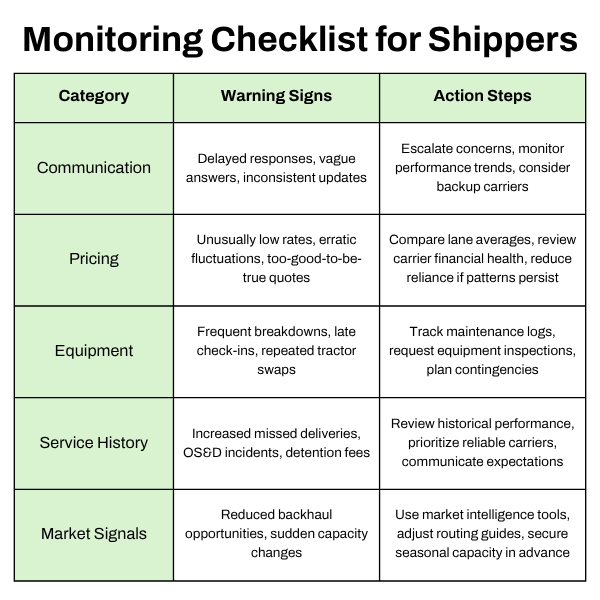
Monitoring Checklist for Shippers
To make these red flags actionable, shippers should implement a monitoring system that tracks:
1. Communication
Watch for delayed responses, vague answers, or inconsistent updates. If these occur, escalate concerns, monitor performance trends, and consider having backup carriers ready.
2. Pricing
Be alert to unusually low rates, erratic fluctuations, or quotes that seem too good to be true. Compare rates against lane averages, review the carrier’s financial health, and reduce reliance on carriers showing persistent concerning patterns.
3. Equipment
Track signs like frequent breakdowns, late check-ins, or repeated tractor swaps. Maintain detailed maintenance logs, request equipment inspections when needed, and plan contingencies to avoid disruptions.
4. Service History
Monitor for increases in missed deliveries, overages/shortages/damages (OS&D), or detention fees. Review the carrier’s historical performance, prioritize reliable carriers, and communicate expectations clearly.
5. Market Signals
Keep an eye on reduced backhaul opportunities or sudden capacity changes. Leverage market intelligence tools, adjust routing guides accordingly, and secure seasonal capacity in advance when possible.
Using this type of checklist helps shippers detect early warning signs before they escalate into service failures.
Real-World Examples
Example 1: Regional Broker Failure
A mid-sized shipper relied heavily on a single regional broker for high-volume lanes in the Midwest. The broker initially delivered consistent service at competitive rates. Over a few months, communication slowed, rates fluctuated dramatically, and equipment failures became frequent.
By monitoring these early warning signs, the shipper reduced reliance on that broker gradually, establishing agreements with more reliable carriers. When the broker ultimately failed to meet service commitments, the shipper avoided major disruption because contingency carriers were already in place. This proactive approach saved thousands in lost revenue, avoided customer complaints, and preserved trust.
Example 2: Equipment Issues Leading to OS&D
A national food distributor used a fleet of refrigerated trailers through a new carrier. Within two weeks, trailers experienced repeated refrigeration failures, causing spoiled products and missed deliveries. Because the shipper tracked maintenance issues and monitored late check-ins, they were able to remove the carrier from rotation before larger losses occurred.
This demonstrates the importance of viewing equipment as a key metric for carrier health, rather than assuming minor failures are one-offs.
The Big Picture
Recognizing the warning signs of carrier or broker instability is not about suspicion or micromanaging. It is about risk management and proactive planning. Supply chains are complex and interdependent, and a single weak link can disrupt multiple stages of operations.
By paying attention to communication, pricing, and equipment performance, shippers gain insight into the operational and financial health of their partners. This knowledge allows them to make informed decisions, safeguard their operations, and protect customer relationships.
Reliability is the foundation of a strong supply chain. The carriers you work with directly influence your ability to deliver on commitments, meet customer expectations, and maintain profitability.
Practical Steps for Shippers
- Track and Score Carriers: Develop a scoring system that evaluates communication, equipment reliability, pricing consistency, and service history.
- Conduct Regular Reviews: Review carrier performance monthly, especially during peak seasons.
- Maintain Contingency Capacity: Keep relationships with backup carriers for high-volume or time-sensitive lanes.
- Use Data-Driven Decision Making: Leverage real-time data on market conditions, capacity, and rates to anticipate issues.
- Educate Your Team: Ensure operations staff and logistics managers understand red flags and escalation procedures.
By combining monitoring with proactive planning, shippers can protect their network from service disruptions, even when a carrier or broker is under stress.
About the Author: Albert Mathewson, Senior Supply Chain Strategist at Service First Logistics
This analysis is provided by Albert Mathewson, a Senior Supply Chain Strategist at Service First Logistics with nearly a decade of experience across refrigerated, dry van, flatbed, oversize, and cross-border freight. Albert focuses on helping shippers identify risk early, stabilize their networks, and operate with confidence in a constantly changing market.
As part of the Service First Logistics thought leadership team, Albert regularly shares practical, data-backed logistics insights to help companies navigate the challenges of transportation today. If you would like to discuss carrier performance signals or strengthen your routing strategy, Albert is always available to share insights and guidance.