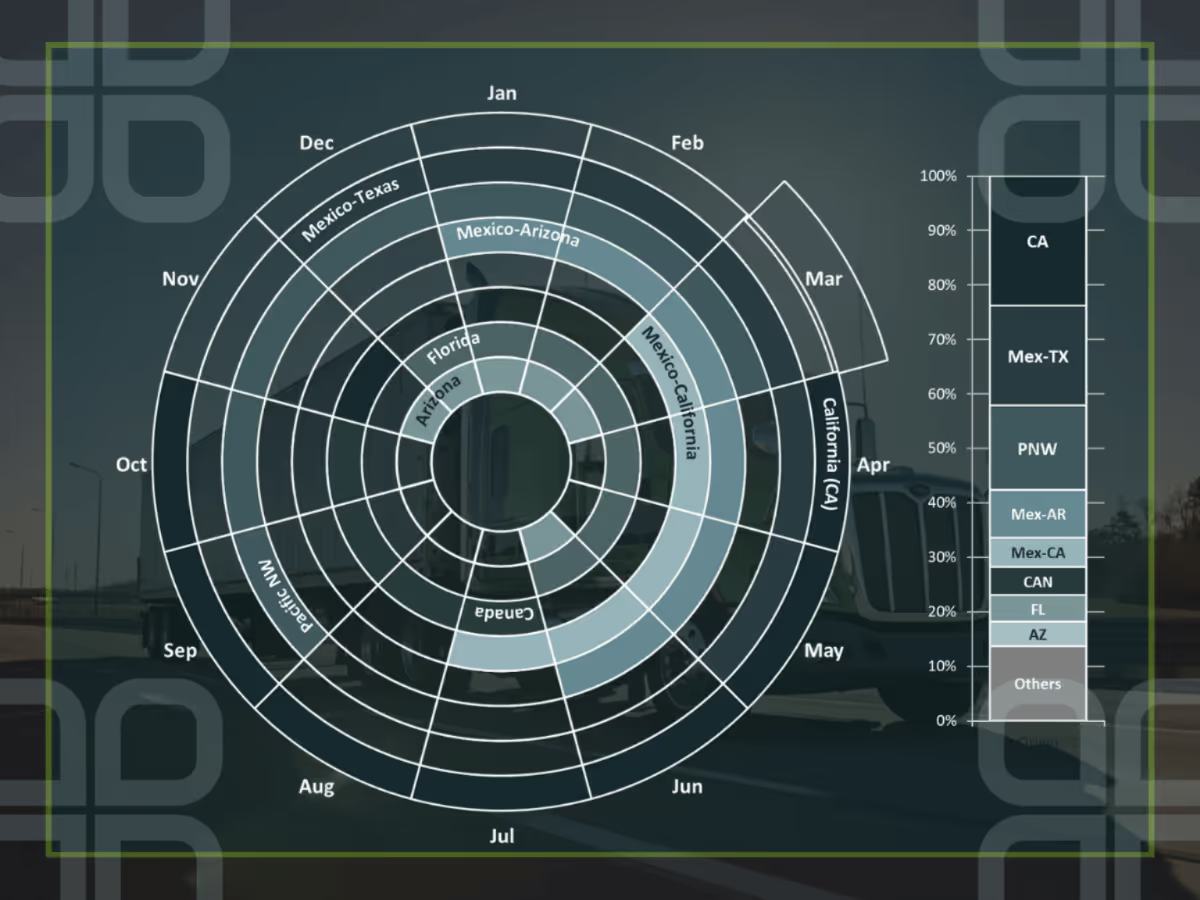

The best transportation plan today might not be the best one next month.
That is simply the reality of freight.
Volumes change. Capacity shifts. Produce seasons move from one region to another. Customer priorities change. New lanes open while others slow down.
A transportation strategy can work extremely well under one set of conditions and become inefficient when those conditions change.
That is why flexibility matters.
Not as a backup plan. Not as a response to everything going wrong.
As part of the strategy from the beginning.
The strongest freight programs are not built around doing everything the same way every time. They are built around understanding the goal and having more than one way to get there.
Rigid transportation strategies have a short shelf life
Consistency is important in logistics.
But consistency and rigidity are not the same thing.
There is value in established carriers, repeatable processes, dependable lanes, and predictable schedules. Those things create structure.
The problem comes when that structure leaves no room for change.
A carrier that is the right fit at one volume level may not be the right fit when demand increases. A route that works during normal conditions may become inefficient during peak season. A schedule built around one customer requirement may need to change when that customer's operation changes.
Freight does not stay still long enough for every solution to remain the best solution forever.
Strong transportation strategies recognize that.
They create consistency where it matters while leaving enough room to adjust where it does not.
Capacity is never completely consistent
Capacity is one of the clearest examples of why flexibility matters.
It moves.
Different markets tighten at different times. Seasonal freight creates pressure in certain regions. Equipment availability changes. Carrier networks shift.
That means relying too heavily on one source of capacity can create problems when market conditions change.
A flexible strategy creates more options.
That might mean developing relationships with carriers that serve different regions, understanding where additional capacity can come from during peak periods, or building a network that can expand and contract as shipping needs change.
The goal is not to use as many carriers as possible.
More is not automatically better.
The goal is to have the right relationships available for the freight being moved.
Because when capacity changes, the strength of a transportation strategy often comes down to the options that already exist.
Flexibility starts before something goes wrong
It is easy to think of flexibility as something that matters during a disruption.
But the best time to create flexibility is before it is needed.
That means understanding which parts of a transportation strategy can change and which cannot.
Maybe a delivery appointment is fixed, but the pickup time has room to move.
Maybe temperature requirements cannot change, but the carrier can.
Maybe the destination is fixed, but there are multiple ways to route the freight there.
Every shipment has constraints.
Flexibility comes from understanding those constraints instead of treating every part of the plan as equally fixed.
That gives teams room to make adjustments without compromising what actually matters.
Different freight requires different solutions
There is no universal transportation strategy.
A time-sensitive produce load does not have the same priorities as freight with a wider delivery window.
A customer shipping consistent weekly volume may need a different capacity strategy than one whose volume changes dramatically throughout the year.
A shipment moving across the country may require a different approach than one moving a few hundred miles.
The freight itself should help determine the solution.
That sounds obvious, but standardized processes can sometimes push transportation in the opposite direction.
When everything is forced through the same strategy, teams may gain simplicity while losing effectiveness.
Flexibility allows the process to fit the freight instead of forcing the freight to fit the process.
Strong carrier relationships create options
Flexibility does not come from having an endless carrier list.
It comes from having the right relationships.
When logistics teams understand their carrier network, where carriers operate, what equipment they have, which lanes they know well, and where they perform best, they can make better decisions about where each partner fits.
That becomes especially valuable as freight needs change.
A strong carrier relationship can open capacity in a difficult market. A carrier with experience on a specific lane may offer a better solution as volume increases. A broader network can help support customers whose shipping patterns change throughout the year.
Those options are not created overnight.
They come from consistently building and maintaining relationships before they are needed.
That is what makes a carrier network flexible without making it unnecessarily complicated.
Flexibility matters when demand changes
Not every freight challenge is a disruption.
Sometimes business simply changes.
A customer gains a new account.
A retailer increases an order.
A produce season starts earlier than expected.
A company expands into a new region.
Suddenly, the transportation network needs to support something it was not originally built around.
That is where flexibility becomes a growth issue, not just an operational one.
A transportation strategy that only works at today's volume can eventually become a limitation.
One that can scale, shift, and support new needs gives companies more room to grow without rebuilding the entire process every time something changes.
Consistency does not require doing everything the same way
One of the biggest misconceptions about flexibility is that it creates inconsistency.
It does not have to.
The process can change while the standard stays the same.
A different carrier can still meet the same service expectations.
A different route can still protect the same delivery window.
A different capacity solution can still support the same customer requirements.
The goal is not to make every shipment look identical.
The goal is to create a consistent outcome.
That distinction matters.
Because sometimes the most reliable transportation strategy is the one that is willing to change how the work gets done in order to protect what actually matters.
Flexibility is becoming part of good freight management
Freight will continue to change.
Markets will tighten and loosen. Volumes will rise and fall. Seasonal patterns will shift. Customer needs will evolve.
Transportation strategies have to be able to move with them.
At Service First Logistics, we understand that no two customers, shipments, or seasons are exactly the same. That is why we focus on building solutions around the freight in front of us rather than assuming one approach will work for everything.
The goal is not change for the sake of change.
It is having the ability to adjust when a better solution is needed.
Final Thought
A strong logistics strategy needs structure.
But it also needs room to move.
Flexibility gives companies the ability to respond to changing capacity, volume, markets, and customer needs without rebuilding their transportation strategy from the ground up every time something shifts.
The best solution will not always look the same.
And it does not need to.
Because consistency in freight is not about doing everything the same way every time.
It is about consistently getting to the right outcome.